By ScoreGap Research
How to Review LSAT Practice Tests Effectively
The three-pass review method for LSAT® practice tests. Turn wrong answers into score gains with blind review, error classification, and pattern tracking.
Taking practice tests without reviewing them properly is one of the least productive things you can do in LSAT® prep. It's also one of the most common mistakes we see.
Here's the pattern: you spend three-plus hours on a full-length PT under timed conditions. You check your score. You feel good or bad. Then you move on to the next one. Maybe you glance at the questions you got wrong. Maybe you skim an explanation or two. But you don't actually sit down and do the hard, uncomfortable work of figuring out why you missed what you missed.
This is how people take dozens of practice tests and barely see their score move. The test itself is just a measurement. The review is the workout.
Why the review matters more than the test
A practice test tells you where you are right now. It doesn't build skill on its own; it's a diagnostic.
The review is where you convert that diagnostic into actual improvement. When you analyze a wrong answer (really analyze it, not just read the explanation and nod) you're training yourself to recognize that pattern correctly next time. When you identify that you've missed the same type of question across three tests, you've found the specific skill gap that's costing you points. That's information you can act on.
What separates top scorers is how much they extract from each test. A smaller stack of thoroughly reviewed PTs beats a bigger one that only got five-minute answer checks.
The three-pass review method
The most effective review process has three distinct passes. Don't try to combine them. Each one serves a different purpose.
Some prep companies recommend reviewing immediately while the test is fresh in memory. For most people, post-test fatigue leads to shallow analysis, and a 24-hour gap between testing and reviewing forces you to engage with the question on its own terms rather than relying on vague memory of your reasoning. The exception: if you're consistently scoring 170+ and your misses are almost all pacing-related, a quick same-day Pass 1 can work because the analysis is narrower and you're less likely to be cognitively drained.
Pass 1: check and mark (~15 minutes)
Go through the answer key and mark every question you got wrong. Don't look at explanations yet. Don't try to figure out why. Just identify the misses and note the question type for each one.
This pass should be quick, fifteen minutes at most. The goal is to get a clean inventory of what went wrong. How many did you miss in each section? Which question types showed up most? Were the misses clustered at the end of sections (a pacing issue) or scattered throughout (a skills issue)?
This first pass also serves an important emotional purpose. It separates the scoring from the analysis. Check your score, feel whatever you feel about it, and then move on to the work.
Pass 2: re-attempt untimed (30–45 minutes)
This step is commonly known as “blind review”, a term popularized by 7Sage, and it’s the single most diagnostic step in your review process. We’ve structured it as Pass 2 of three rather than a standalone method because blind review without error categorization (Pass 1) and root-cause analysis (Pass 3) leaves value on the table. For the standalone method, including the flag-as-you-go template and how to read the timed-versus-blind score gap, see the blind review guide.
Go back to every question you got wrong and try to answer it again, without time pressure and without looking at the correct answer. Just you and the question.
This is the most revealing part of the review. For each wrong answer, one of two things will happen:
You'll get it right this time. This means you had the skill to answer the question correctly. You missed it because of time pressure, carelessness, or a reading error under stress. These are your "free points", questions you can reclaim by adjusting your pacing or attention strategy. They don't require learning new skills.
You'll get it wrong again (or be unsure). This means you have a genuine skill gap for this question type. These are the questions that require actual study, reviewing the reasoning principle, drilling similar questions, or learning a new approach to the question type.
The distinction between these two categories is everything. The fix for "I can do this but I ran out of time" is completely different from the fix for "I don't understand how this question type works." Most students treat all wrong answers the same and wonder why their studying doesn't translate to score improvement.
Pass 3: analyze the why (45–60 minutes)
Now go through each wrong answer a third time with the correct answer revealed. For each one, write down three things: why your answer was wrong, why the correct answer is right, and what specific reasoning error you made.
This is where it gets uncomfortable, because it requires honesty. It's easy to read an explanation and think "oh, of course." It's harder to admit that you picked answer choice B because you didn't actually identify the conclusion, or because you confused correlation with causation, or because you panicked with 30 seconds left and guessed.
Be specific. "I didn't read carefully" is not an analysis. "I interpreted 'most' as 'all' and treated the conditional as biconditional" is an analysis. The more precise you are about the error, the more likely you are to catch it in real time on the next test.
For a structured format for recording these analyses, see our guide to keeping a wrong answer journal for the LSAT®.
Section-specific review tips
Since August 2024, the scored LSAT® consists of two Logical Reasoning sections and one Reading Comprehension section (plus one unscored variable section that may be LR or RC). LR now accounts for roughly two-thirds of your scored questions, which means your LR review process deserves proportionally more attention.
Logical Reasoning
For every wrong LR question, identify two things: the reasoning flaw in the stimulus (if applicable) and the trap in the wrong answer you picked. LR wrong answers almost always have a specific reason they're attractive. They use language from the stimulus, they address the right topic but the wrong logical relationship, or they're partially correct but too extreme.
Categorize your errors by question type. If you're missing Strengthen and Weaken questions, your issue is likely with identifying assumptions. If you're missing Sufficient Assumption and Must Be True questions, your issue is with conditional logic. Different question types require different study approaches.
Reading Comprehension
RC errors usually fall into three buckets. Detail questions: you couldn't find or misread the relevant passage text. Inference questions: you went beyond what the passage actually supports. Main point questions: you focused on a supporting detail instead of the central argument.
For RC, pay special attention to whether your errors are concentrated in particular passage types. Some people struggle with science passages but ace legal theory. Others fall apart on comparative reading sets. The pattern tells you where to focus your practice. When reviewing RC wrong answers, always go back and identify the specific lines in the passage that support the correct answer, grounding your analysis in the text trains you to rely on evidence rather than impressions.
Logic Games (older PTs only)
Note: Per LSAC, the Analytical Reasoning (Logic Games) section was eliminated from the LSAT® starting with the August 2024 administration, replaced by a second Logical Reasoning section. If you're working through older PrepTests (PT 1–99), these tips still apply.
Wrong answers in Logic Games almost always trace back to one of two problems: your initial setup was incomplete (you missed a deduction or misdiagrammed a rule), or you made an inference error while working through a specific question.
During review, go back and redo the full game setup. Check every rule. Make every deduction. If your setup was wrong, that's your issue. It doesn't matter how fast you are if your foundation is flawed. If your setup was right but you still missed questions, the problem is in your reasoning from the setup, which is a different skill to drill.
Common mistakes when reviewing LSAT® practice tests
Reviewing too quickly. A proper review of a full-length PT takes 90 minutes to two hours across all three passes. If you're doing it in twenty minutes, you're skimming, not analyzing. This isn't a task you can rush. The depth of your analysis directly determines how much your score improves.
Not categorizing your errors. If your review produces a list of 28 wrong answers with no categorization, you haven't learned much. You need to see that 8 of those were Flaw questions, or that 6 were in the last five questions of the section, or that all your RC misses were inference questions. Categories are what turn individual data points into actionable patterns.
Only reading the correct answer explanation. If you just read why the right answer is right, you learn one thing. If you also figure out why each wrong answer is wrong, especially why the answer you picked is wrong, you learn four things. The wrong answers are designed to exploit specific reasoning errors. Understanding the traps is as valuable as understanding the correct logic.
Reviewing immediately after the test. You're mentally exhausted after a full-length PT. Your analysis will be shallow and you'll be more interested in being done than in being thorough. Take a break. Come back to the review the next day when you're fresh. Your Sunday self will do better work than your Saturday-evening self.
Spotting patterns across tests
A single test's review is valuable. But the real power comes from looking across multiple tests. After three or four fully reviewed PTs, you should be able to answer these questions:
- Which question types am I consistently missing?
- Which sections am I weakest in?
- Are my errors concentrated at certain difficulty levels?
- Am I losing more points to skill gaps or to pacing?
- Is my accuracy improving in the areas I've been drilling?
For a broader framework on measuring improvement, see our guide to tracking LSAT® progress.
This is where most people's review process breaks down, because tracking patterns across tests manually is tedious. You'd need to go back through multiple spreadsheets, count question types, and calculate your accuracy rates by category. (If you're doing this manually, a structured wrong answer journal template makes the tracking much easier.)
This is where tracking tools earn their keep. ScoreGap, for example, sits alongside your LawHub™ score report and tracks accuracy by question type across tests automatically, useful if you want the pattern recognition handled for you. Spreadsheets work too; the key is that you're tracking consistently across tests, not just reviewing each PT in isolation.
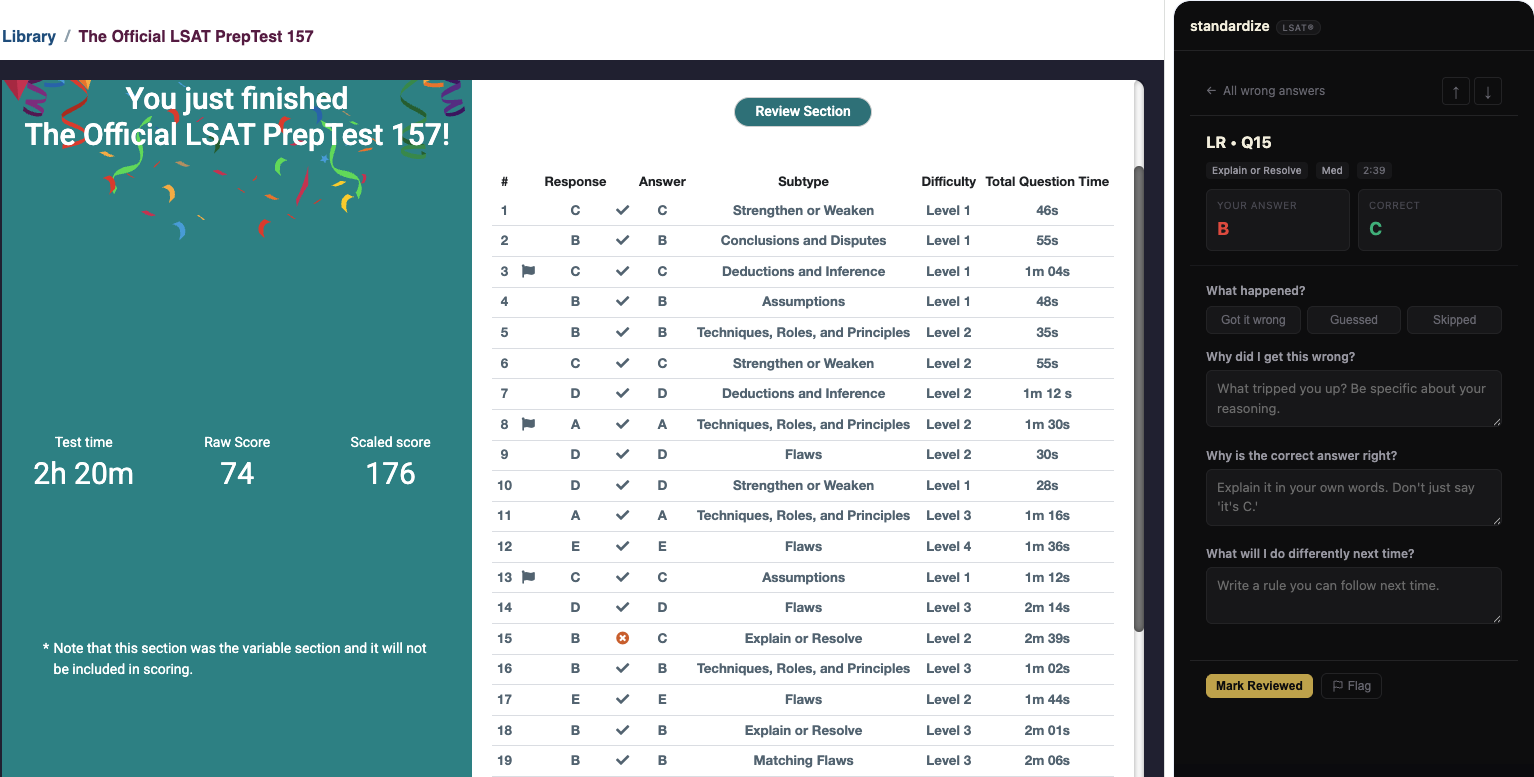
But whether you use a tool or a stack of spreadsheets, the principle is the same: your review process should produce patterns, not just a list of questions you got wrong.
Building a review routine
Here's a realistic schedule that works for most people studying part-time:
Saturday: Take a full-length PT under timed conditions. Check your score. Do Pass 1 (mark and categorize). Stop.
Sunday: Do Pass 2 (untimed re-attempt) and Pass 3 (analyze the why). Write up your journal entries. Identify your top two or three patterns for the week.
Monday through Friday: Drill the specific question types and skills that your review identified as weak points. Before your next PT, spend 15 minutes reading through your journal entries from the last two tests.
If you're studying full-time and taking 2–3 PTs per week, you still need to complete all three passes before taking another test. Taking a new PT before finishing your review of the last one defeats the purpose, you're generating new data before processing the old data.
If your review surfaces five different weak areas, pick the two with the highest question frequency on recent tests and drill those first. Trying to fix everything simultaneously usually means fixing nothing.
This cycle (test, review, drill, repeat) is the fundamental engine of LSAT® score improvement. The review is the step that makes everything else work. Skip it, and you're putting in hours without making progress.
If your score has plateaued despite consistent practice, the review process is the first place to look. Go back to your most recent PT, pull out the wrong answers, and work through the three passes. One properly reviewed test will tell you more about what to study next than three unreviewed ones ever could.
FAQs
How long should it take to review an LSAT practice test?
A thorough review of a full-length practice test takes about 90 minutes to two hours, across three passes, roughly 15 minutes to mark and categorize, 30–45 minutes to re-attempt untimed, and 45–60 minutes to analyze why. Reviewing in 20 minutes is skimming, not analyzing.
What is blind review on the LSAT?
Blind review (a term popularized by 7Sage) means re-attempting each question you got wrong without time pressure and without seeing the correct answer. If you get it right untimed, the miss was pacing or carelessness; if you still miss it, you have a genuine skill gap. It is Pass 2 of the three-pass method.
Should I review my practice test the same day or the next day?
Usually the next day. After a full-length test you are mentally drained, so same-day analysis tends to be shallow, and a 24-hour gap forces you to engage with the question fresh instead of from memory. The exception is consistent 170+ scorers whose misses are almost all pacing.
How do I tell a pacing mistake from a skill gap?
Re-attempt the question untimed. If you get it right with no clock, it was a pacing or attention problem, reclaimable free points. If you still miss it, it is a skill gap that needs targeted study or drilling.
What is the three-pass LSAT review method?
Pass 1: check the answer key, mark every miss, and categorize by question type (~15 minutes). Pass 2: re-attempt each miss untimed (30–45 minutes). Pass 3: with the answer revealed, write why your choice was wrong, why the correct answer is right, and the specific error you made (45–60 minutes).